

2026 Latest Actual4Labs HPE7-A01 PDF Dumps and HPE7-A01 Exam Engine Free Share: https://drive.google.com/open?id=1KIAenyCVPRLaw0UIKW56DjiyUVS1F2cu
Our HPE7-A01 study materials will be your best choice for our professional experts compiled them based on changes in the HPE7-A01 examination outlines over the years and industry trends. Our HPE7-A01 test torrent not only help you to improve the efficiency of learning, but also help you to shorten the review time of up to even two or three days, so that you use the least time and effort to get the maximum improvement to achieve your HPE7-A01 Certification.
HP HPE7-A01 Exam, also known as the Aruba Certified Campus Access Professional exam, is a certification exam designed for IT professionals who want to validate their skills and knowledge in implementing and configuring Aruba wireless and wired networks. Aruba Certified Campus Access Professional Exam certification is ideal for IT professionals who work with small to medium-sized enterprise networks and want to excel in their careers.
>> HPE7-A01 Exam Sample Questions <<
The second format is a web-based practice exam which offers a flexible and accessible option for students trying to assess and improve their preparation for the HP Certification Exams. The HPE7-A01 web-based practice test can be accessed online through browsers like Firefox, Microsoft Edge, Google Chrome, and Safari. Customers need a stable internet connection in order to access web-based formats easily without facing issues.
By becoming Aruba Certified Campus Access Professionals, IT professionals can enhance their credibility and demonstrate their expertise in designing and deploying secure wireless networks using Aruba products and solutions. Aruba Certified Campus Access Professional Exam certification can also lead to career advancement opportunities and increased earning potential. Additionally, certified professionals gain access to Aruba's online community of experts, which provides opportunities for networking, knowledge sharing, and professional development.
NEW QUESTION # 48
Your manufacturing client is having installers deploy seventy headless scanners and fifty IP cameras in their warehouse. These new devices do not support 802.1X authentication.
How can HPE Aruba Networking reduce the IT administration overhead associated with this deployment while maintaining a secure environment using MPSK?
Answer: C
Explanation:
MPSK Local is a feature that can reduce the IT administration overhead associated with deploying devices that do not support 802.1X authentication while maintaining a secure environment. MPSK Local allows the switch to automatically generate and assign unique pre- shared keys for devices based on their MAC addresses, without requiring any configuration on the devices or an external authentication server. The other options are incorrect because they either require manual intervention by the installers or the MPSK gateway, or they do not provide unique pre-shared keys for devices.
NEW QUESTION # 49
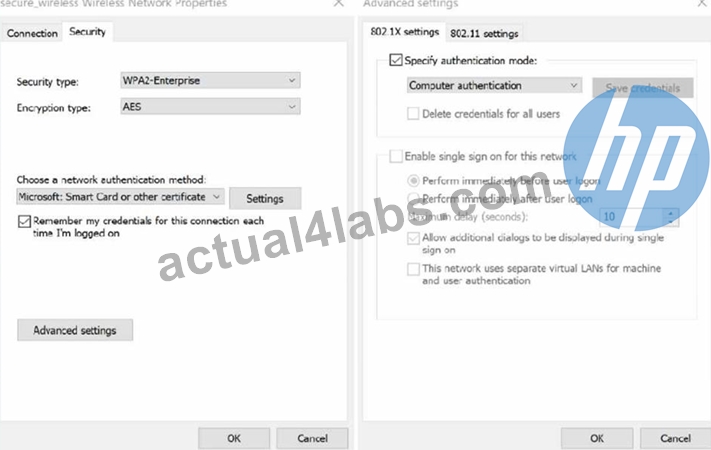
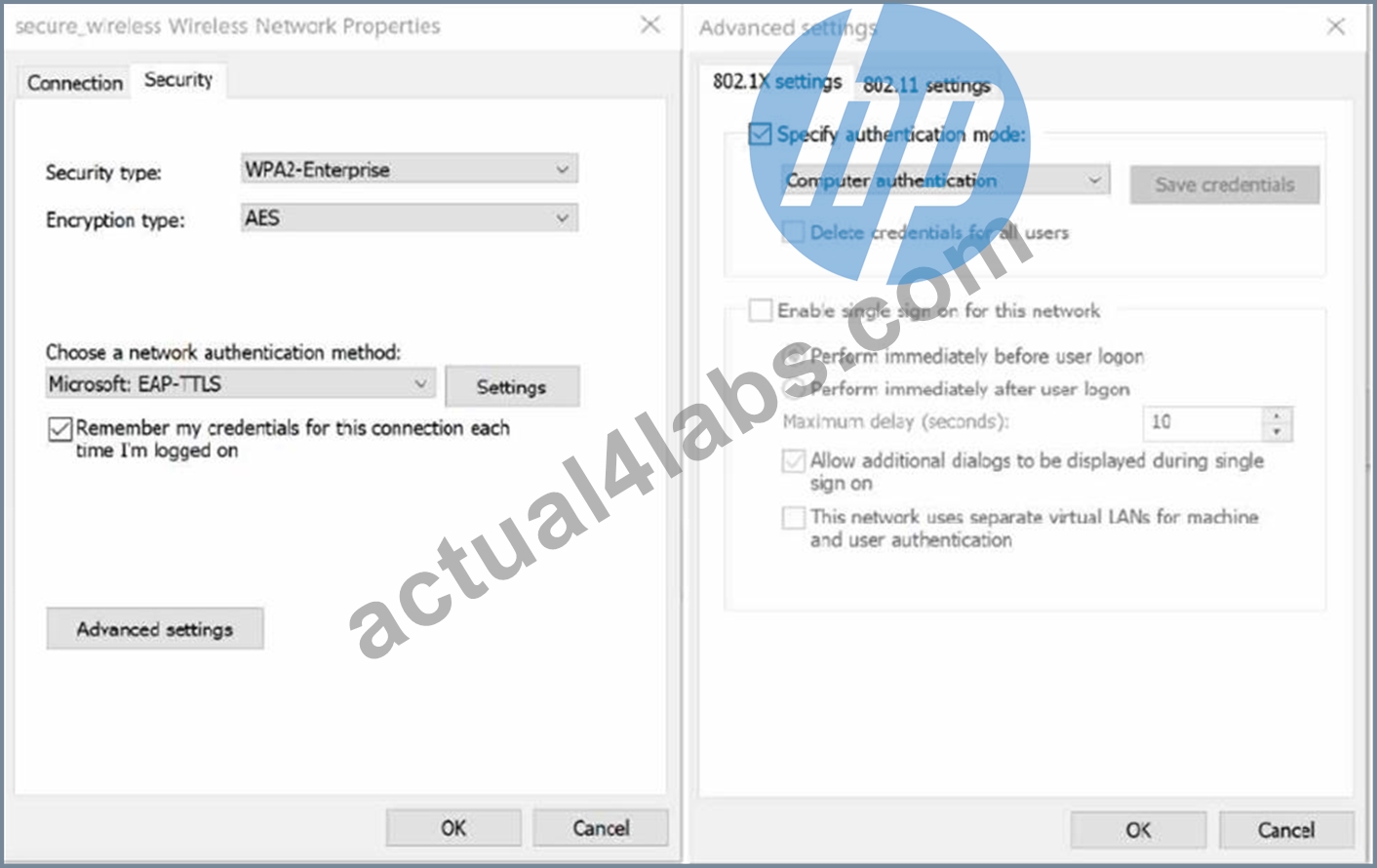
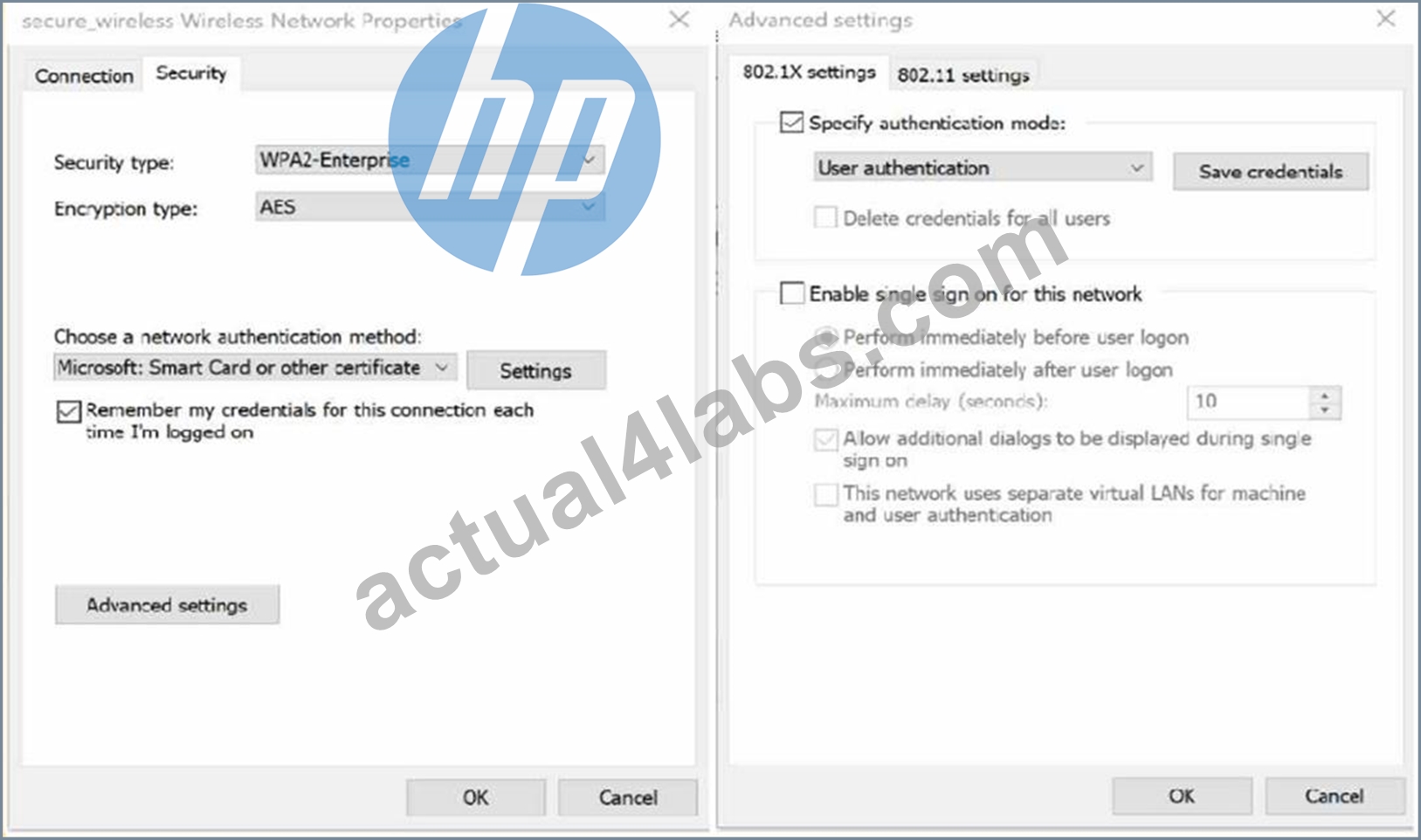
A company is in the planning stages to migrate to all their wireless domain laptops from WPA2 from WPA2 EAP-PEAP to EAP-TLS with machine Authentication. The administrator is testing a new Group Policy (GPO) that was pushed to only a few windows domain Laptops. The policy will configure the wireless profile to perform machine and certificate-based authentication.
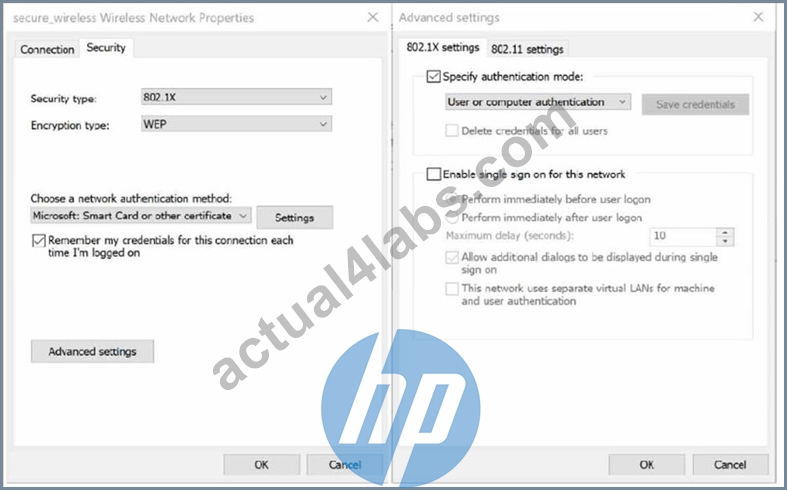
To support this new initiative the administrator also configured a new HPE Aruba Networking ClearPass 802.1X wireless service that only allows devices that successfully perform machine and certificate-based authentication. After successfully pushing the GPO, the Windows laptops are unable to join the configured `'secure_wireless'' SSID as shown below.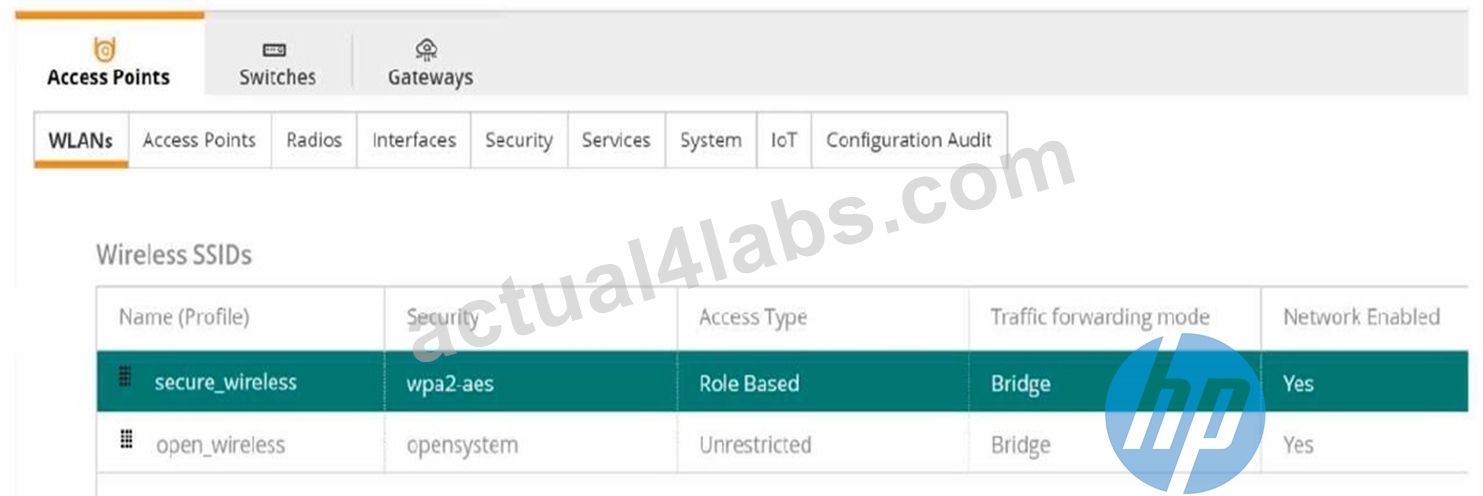
Which configuration setting would resolve this issue?
Answer: B
Explanation:
This The chosen configuration matches the ClearPass policy requiring certificate-based machine authentication and will allow the laptop to join the "secure_wireless" SSID.
NEW QUESTION # 50
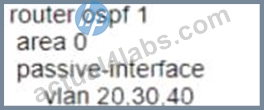
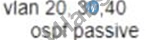
Your Aruba CX 6300 VSF stack has OSPF adjacency over SVI 10 with LAG 1 to a neighboring device The following configuration was created on the switch: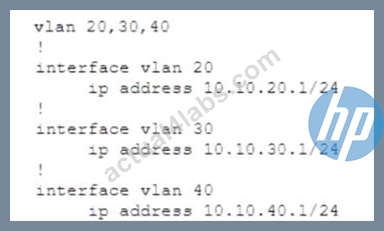


Answer: A
Explanation:
OSPF (Open Shortest Path First) is a routing protocol that uses link-state information to calculate the best path to each destination in the network. OSPF establishes adjacencies with neighboring routers to exchange routing information and maintain a consistent view of the network topology1.
To establish an OSPF adjacency, the routers need to have some common parameters, such as the area ID, the network type, the hello interval, the dead interval, and the authentication method2. The routers also need to have a matching subnet mask on the interface that connects them3.
In this case, the Aruba CX 6300 VSF stack has an SVI (Switched Virtual Interface) on VLAN 10 with an IP address of 10.1.1.1/24 and a LAG (Link Aggregation Group) on port 1/1/1 and port 2/1/1 that connects to a neighboring device. The SVI is configured with OSPF area 0 and network type broadcast. The LAG is configured with OSPF passive mode, which means that it will not send or receive OSPF hello packets.
The neighboring device has an interface with an IP address of 10.1.1.2/24 and a LAG on port 1/0/1 and port
2/0/1 that connects to the Aruba CX 6300 VSF stack. The interface is configured with OSPF area 0 and network type broadcast.
Since the Aruba CX 6300 VSF stack and the neighboring device have the same area ID, network type, subnet mask, and default hello and dead intervals on their interfaces, they will be able to establish an OSPF adjacency over SVI 10 with LAG 1. The OSPF passivemode on the LAG will not affect the adjacency, because it only applies to the LAG interface, not the SVI interface.
NEW QUESTION # 51
Which statements are true about VSX LAG? (Select two.)
Answer: D,E
Explanation:
The correct answers are A and D.
According to the web search results, VSX LAG is a feature that allows multiple PSKs to be used on a single SSID, providing device-specific or group-specific passphrases for enhanced security and deployment flexibility for headless IoT devices1.VSX LAGs span both aggregation switches and appear as one device to partner downstream or upstream devices or both when forming a LAG with the VSX pair2.
One of the statements that is true about VSX LAG is that the total number of configured links may not exceed
8 for the pair or 4 per switch1. This means that a VSX LAG across a downstream switch can have at most a total of eight member links, and a switch can have a maximum of four member links.When creating a VSX LAG, it is recommended to select an equal number of member links in each segment for load balancing1.
Another statement that is true about VSX LAG is that outgoing traffic is preferentially switched to local members of the LAG2. This means that when active forwarding and active gateway are enabled, north-south and south-north traffic bypasses the ISL link and uses the local ports on the switch.This optimizes the traffic path and reduces the load on the ISL link2.
The other statements are false or not relevant for VSX LAG. Outgoing traffic is not switched to a port based on a hashing algorithm, which may be either switch in the pair. This is a characteristic of MLAG (Multi-Chassis Link Aggregation), which is a different feature from VSX LAG. LAG traffic is not passed over VSX ISL links only while upgrading firmware on the switch pair. This is a scenario that may occur when performing hitless upgrades, which is a feature that allows software updates without impacting network availability. The number of VSX lags that can be configured on all 83xx and 84xx model switches is not 255, but depends on the switch model and firmware version. For example, the AOS-CX 10.04 supports up to 64 VSX lags for 8320 switches and up to 128 VSX lags for 8325 and 8400 switches.
NEW QUESTION # 52
A client is connecting to 802.1X SSID that has been configured in tunnel mode with the default AP-group settings.
After receiving Access-Accept from the RADIUS server, the Aruba Gateway will send Access-Accept to the AP through which tunnel?
Answer: A
Explanation:
According to the Aruba Documentation Portal1, 802.1X is a standard for port-based network access control that uses a RADIUS server to authenticate and authorize wireless clients. 802.1X can be configured in different modes, such as bridge mode, tunnel mode, or split tunnel mode.
Option C: GRE tunnel
This is because option C shows how to configure an SSID in tunnel mode with the default AP-group settings on an Aruba switch. In tunnel mode, all client traffic from the access points is tunneled back to the controller and the controller would in turn put the client traffic onto the network2. The GRE protocol is used to encapsulate and decapsulate the traffic between the access points and the controller3.
Therefore, option C is correct.
1: https://www.arubanetworks.com/techdocs/AOS-CX/10.06/HTML/5200-7696/GUID-581D2976-694B-46C7-8497-F6B788AA05B2.html
2: https://community.arubanetworks.com/discussion/bridge-and-tunnel-mode
3: https://www.twingate.com/blog/ipsec-tunnel-mode
NEW QUESTION # 53
......
Valid HPE7-A01 Exam Tips: https://www.actual4labs.com/HP/HPE7-A01-actual-exam-dumps.html
P.S. Free 2026 HP HPE7-A01 dumps are available on Google Drive shared by Actual4Labs: https://drive.google.com/open?id=1KIAenyCVPRLaw0UIKW56DjiyUVS1F2cu